
No New London County Mugshot Roster
The first thing to know is plain. There is no New London County mugshot roster. No county booking-photo gallery exists, and no county recent-bookings feed is posted by any office. The reason is structural. Connecticut abolished county government in 1960, and the state folded the old county jails into one system in 1968. New London County is a map area today, not a working government. It has no sheriff who runs a jail and no county records lobby that hands out booking photos.
That changes where a booking photo can sit. A mugshot is taken at intake, when police process an arrest. So the most likely holder is the arresting police agency in the town where the arrest happened. A photo can also appear inside a warrant affidavit or an incident report when it is tied to the arrest paperwork. The Connecticut Department of Correction may keep a photo in its internal custody file. A photo can land in a court filing as well, though court access has its own rules and sealing limits. No county sheriff most-wanted page exists for New London County.
So the search splits across agencies. That is not a dead end. It just means the right office depends on who arrested the person and where the case sits now. Booking photos for someone currently held show up in custody records, while a request to the arresting agency is the route for the original arrest image. The New London County jail inmate records page walks the full custody-lookup chain in more depth.
CT DOC Locator and Photo Caveats
Because the state runs custody, the closest thing to an inmate roster is the Connecticut Department of Correction inmate information search. It is a statewide lookup, not a New London County roster. It covers people held in DOC custody now, both accused people awaiting trial and sentenced people. Both Corrigan Correctional Center and York Correctional Institution are DOC facilities, so someone held there can appear in this system. The CT DOC inmate information page explains the daily-update schedule and the exclusions, and the CT DOC inmate search portal is the live tool.
One caveat matters for booking photos. The DOC locator could not be confirmed to display a mugshot. The live portal blocked review, and the official DOC information page does not state that it shows public booking photos. So treat the DOC search as a custody-and-location tool, not a promised photo gallery. It tells you whether a person is in state custody and at which facility. It is not a stand-in for a county booking-photo feed, because no such feed exists.
The locator also leaves out some groups. Youthful offender records are not included. People held only for federal Immigration and Customs Enforcement are not included either. A just-arrested person may not show up right away, since DOC updates once a day and police or court steps may still be in progress.
Note: The DOC search confirms custody and facility, but a booking photo for a New London County arrest usually rests with the arresting police agency, not the state locator.
Are Booking Photos Public in Connecticut
Connecticut has no separate mugshot statute. Access to a New London County booking photo is handled through general public-records law and the arrest-record statute, not through a county mugshot roster. The broad rule is the Connecticut Freedom of Information Act, which makes agency records public unless a state or federal law says otherwise. The arrest-record statute then sets out what an arrest record must include and adds a hook for records that document or depict the arrest or custody.
That second piece is the key for a booking photo. Section 1-215(c) requires disclosure of other law-enforcement records that document or depict the arrest or custody of a person during a pending prosecution, unless another exemption applies. A booking photo fits that description. Still, release is not guaranteed. The agency can redact parts, claim an exemption, or notify the State's Attorney first. So the law gives a real basis to ask, but not a promise of a yes.
Key Statutes:
Connecticut General Statutes Sec. 1-210 - the FOIA public-records rule; agency records are open to inspection and copying unless a law makes them confidential.
Connecticut General Statutes Sec. 1-215 - defines the public record of an arrest and, in subsection (c), covers records that document or depict an arrest or custody, the best basis for a booking-photo request.
Connecticut General Statutes Sec. 54-142a - the erasure law that clears qualifying police, court, and prosecutor records after dismissals, acquittals, and other set outcomes.
What a New London County Arrest Record Shows
Under Sec. 1-215, the public record of an arrest carries a fixed set of facts. For a warrant arrest, it includes the warrant application and the supporting affidavit unless they are sealed. For an arrest without a warrant, it includes the official arrest, incident, or similar report, with sealed portions held back. The booking photo is not on the core list of basic facts. It rides in under the subsection (c) rule for records that document or depict the arrest or custody, which is why a photo request is treated a bit differently from the basic arrest data.
The table below sorts the common fields. It marks what the statute treats as basic public arrest data and where the booking photo fits.
| Field | What It Shows |
|---|---|
| Name | Name of the arrested person, listed as part of the basic public arrest record. |
| Race | Race of the arrested person, named in the statute as a public arrest fact. |
| Address | Residence address tied to the arrest record, subject to redaction in set cases. |
| Date, Time, Place | When and where the arrest happened, part of the basic public record. |
| Offense | The charge or offense at arrest, which may differ from the later court charge. |
| Warrant or Incident Report | Warrant application and affidavit for warrant arrests, or the arrest/incident report for warrantless arrests, unless sealed. |
| Booking Photo | Released under Sec. 1-215(c) as a record that documents or depicts the arrest or custody; subject to redaction, exemptions, and possible State's Attorney notice. |
Read the offense field with care. The charge at booking can change once the prosecutor reviews the case and files in court. To track how arrest charges turn into the court docket, see the court records after a New London County jail arrest page.
How to Request a Booking Photo
Since no county roster exists, the path to a New London County booking photo is a public-records request to the agency that made the arrest. Start by naming the right office. The arresting agency may be a town or city police department or a Connecticut State Police troop. The Division of Criminal Justice lists local police relevant to arrests in the district, including New London, Norwich, Groton, Waterford, Stonington, East Lyme, Ledyard, Montville, Old Lyme, and Colchester police, along with Connecticut State Police troops such as Troop E. Pick the one that handled the arrest.
- Identify the arresting agency. Match the arrest town to its police department, or to the State Police troop that covers it.
- Write a request for records documenting or depicting the arrest or custody, and name the booking photo if that is what you want.
- Include the full name, date of birth if known, arrest date, the arresting agency, and any court docket or case number.
- Cite Connecticut FOIA and Sec. 1-215 if the agency asks for a legal basis.
- Expect possible notice to the State's Attorney and possible redactions if the case is still being prosecuted.
- If the person is in CT DOC custody and the police agency does not hold the photo, contact the DOC Public Information Office as a secondary route.
Suggested wording for the request, grounded in Sec. 1-215(c), is: "the booking photograph or other record documenting or depicting the arrest or custody of [name] on [date] by [agency]." Treat that as a starting phrase, not a guarantee of release. There is no required statewide form, and Connecticut guidance says inspection cannot be made to depend on a written request, though copies can take processing. Municipal copy fees generally cap at fifty cents per page, and state-agency copies generally run twenty-five cents per page unless another law sets the rate.
The checklist below covers what to put in any booking-photo or arrest-record request so the agency can find the file.
- Full legal name of the arrested person, plus any known aliases.
- Date of birth, when you have it.
- Arrest date and the town where the arrest happened.
- The arresting agency or State Police troop.
- Court docket number or case number, if one exists.
- A plain statement of the exact records you want, naming the booking photo.
Records That May Be Withheld
Not every booking photo will be released. The arrest-record statute carries exemptions, and other laws can block disclosure. An agency may withhold or redact a record for several set reasons, even when the basic arrest facts stay public. This is why a request can come back partly blacked out or fully denied.
What is and isn't public: Basic arrest facts under Sec. 1-215 are generally public, and a booking photo can be released under subsection (c) for a pending case. But records may be withheld or redacted for erased, sealed, or juvenile and youthful-offender matters, for victim or witness identity, or for certain pending law-enforcement concerns. No New London County mugshot gallery exists to browse, so a request to the arresting agency is the lawful route.
The strongest blocks come from erasure and sealing. A record that has been erased is no longer open to the public. A juvenile or youthful-offender matter is protected and stays out of public files. Details that would identify a sexual-assault victim or a witness can be redacted for safety. Some active-investigation concerns can hold a record back for a time. The booking photo follows the same logic, since it is part of the arrest or custody record set.
Booking Photos in Court Records
A booking photo can also become part of a court filing. When that happens, the photo is reached through the court file, not a police request, and court access rules and sealing orders control it. Many criminal cases in the area run through the New London Judicial District Superior Court and the local Geographical Area courts in New London and Norwich. A photo only sits in a court file if it was filed there, so this route does not always apply.
The New London Judicial District courthouse handles the more serious cases in the district. The court directory page below gives its location and access notes for anyone planning to view a file in person.
The Judicial Branch directory lists the courthouse address and directions on its New London Judicial District directions page.
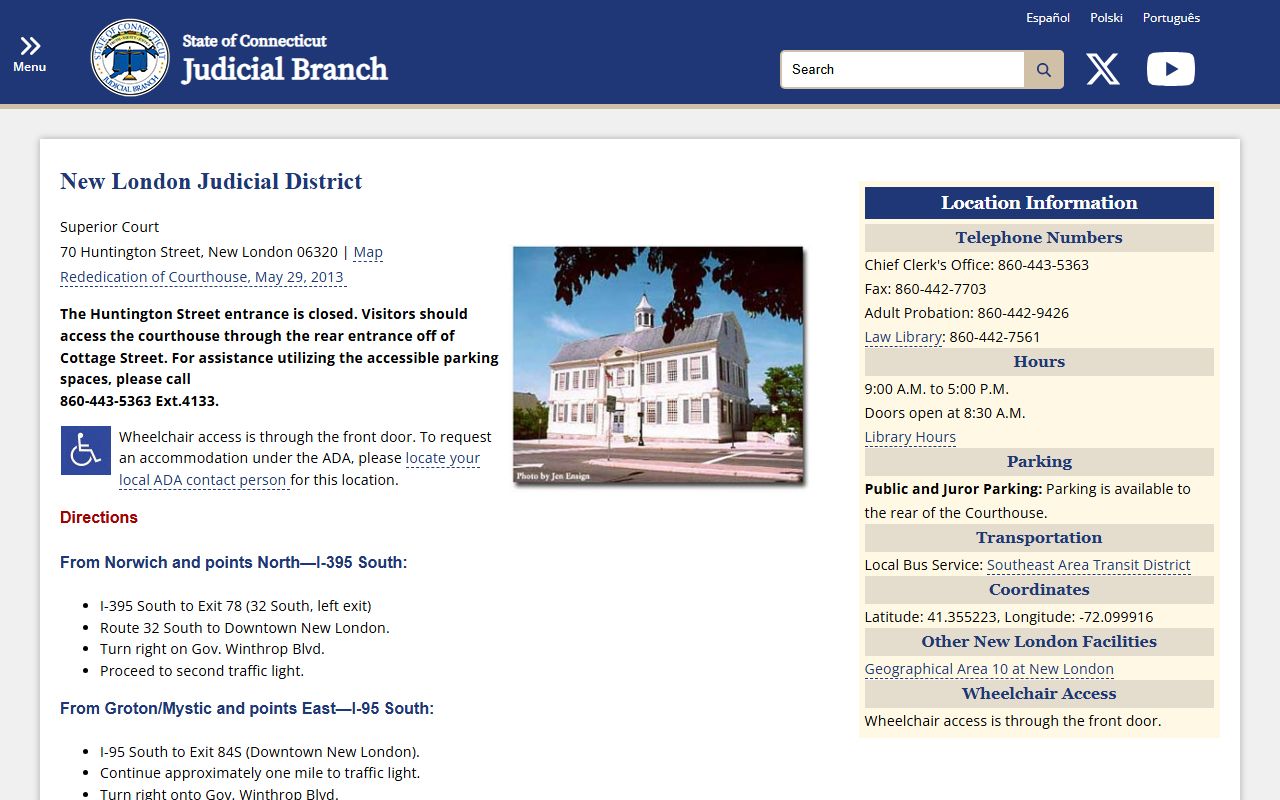
That courthouse is where a filed booking photo or arrest record could be reviewed as a court document, subject to the clerk's rules and any sealing order on the case. Court access is its own track, separate from a police FOIA request for the original arrest image.
Erasure, Sealing, and Clean Slate
People often want a booking photo gone, not found. In Connecticut the route is the erasure law, not a county removal form. There is no county mugshot gallery, so there is no county process that takes a photo down on dismissal. Instead, the records-clearing path runs through the state erasure statute, which can clear qualifying police, court, and prosecutor records after a set outcome.
Section 54-142a can erase records after a not-guilty finding, a dismissal, a nolle once the statutory period passes, a pardon, decriminalization, or clean-slate eligibility. A second statute, Sec. 54-142e, requires bulk-data purchasers and background-screening providers to update and delete erased records before they share them again. Together these laws aim to pull a cleared record out of public circulation, including the related arrest data.
Erasure does not work like a website takedown, and it does not reach private sites that are outside the official-source rule. For the disposition side of a case, the steps to seal or erase a record after a charge resolves are covered on the court records after a jail arrest page.
Note: Erasure under state law is the lawful way to clear a qualifying arrest record, and it is handled through the courts, not through any county booking-photo office.
Commercial Mugshot Sites Are Not Official
Private mugshot-publishing websites are not official sources. They are not run by any Connecticut agency, and they do not follow the records rules that govern a real arrest file. A photo on one of those sites is not the same as the official record, and it carries no guarantee of accuracy or currency.
Many of these sites also push "pay to remove" offers. That model creates problems. Paying one site does not clear the underlying record, does not bind any agency, and does not stop the same image from showing up elsewhere. The lawful way to address a cleared record is the state erasure process, which reaches official files and the bulk-data users who must delete erased records. For an official booking photo, the route is always the arresting agency under FOIA and Sec. 1-215, never a commercial site.
Federal and ICE Photo Differences
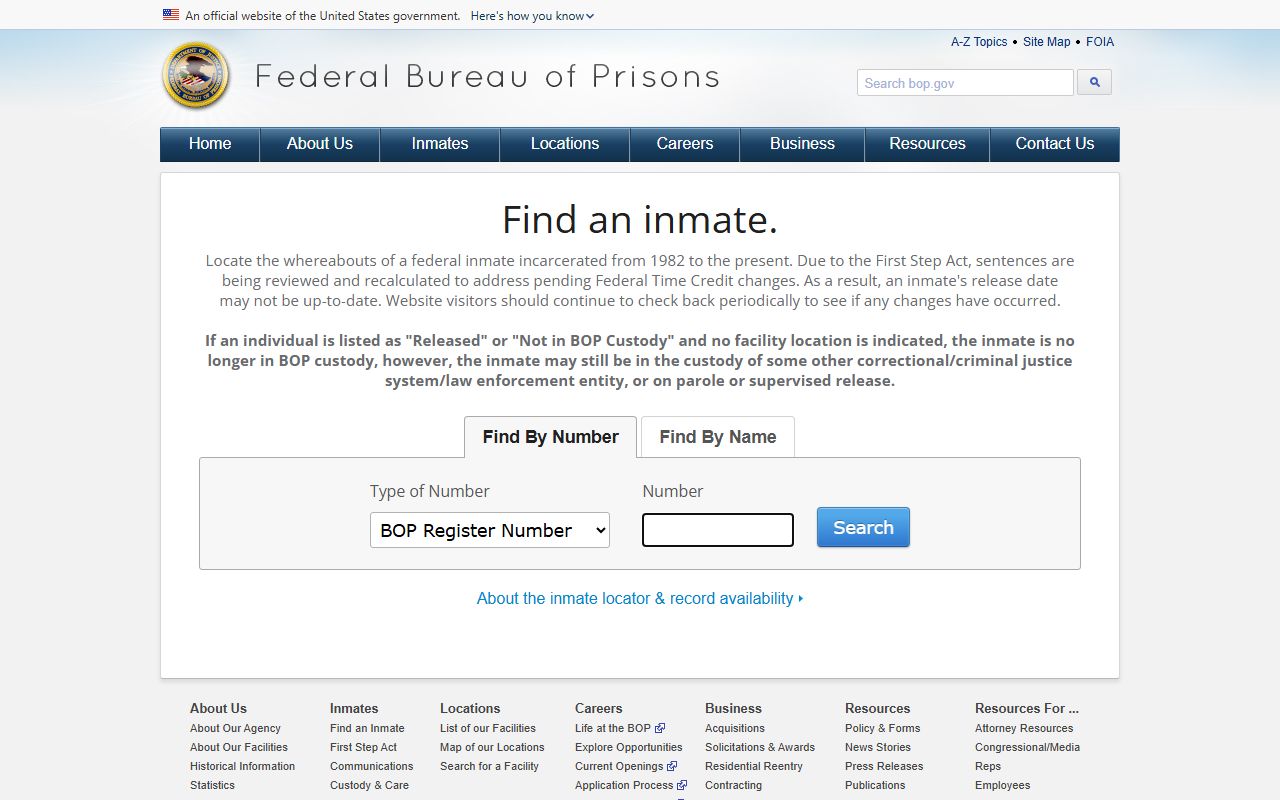
Federal and immigration custody work differently again, and neither system is a mugshot gallery. The Federal Bureau of Prisons runs an inmate locator for people in federal custody. It is a search tool for federal prisoners, not a source of local booking photos. No BOP prison sits in New London County, and Connecticut's federal facility is outside the county.
The BOP locator page below shows the federal search, which is name and register-number based rather than a photo feed.
You can search federal custody on the Federal Bureau of Prisons inmate locator.
Immigration detention is tracked through the ICE Online Detainee Locator, again without local booking photos. The CT DOC database does not include people held only for ICE, so an immigration hold is checked through the ICE detainee locator instead. The short version is simple. State, federal, and immigration systems generally do not publish local booking mugshots, so a New London County booking photo still traces back to the arresting police agency and the state public-records law.