
New London County Court Records After a Jail Arrest
A New London County arrest does not create a court record on its own. Police make the arrest and write the arrest record. Then a state prosecutor, called the State's Attorney, reviews the file. That prosecutor decides what to charge and files those charges with a court. The filing opens a criminal case, and that case is the court record the public can search. The arrest comes first. The court record follows once charges are filed.
Three separate systems hold pieces of the story, and people mix them up often. The arresting agency keeps the arrest record, a police file you request under state public-records law. The Connecticut Department of Correction keeps the custody record, which shows where a held person sits today. The court keeps the case record, which tracks the charges, the dates, and the outcome. For where someone is held and the booking side, see the jail inmate records page. Booking photos are covered on the jail mugshots page.
From Arrest to a New London County Court Case
The path runs in a steady order. It helps to picture it as a short flow: arrest, then booking, then bail review, then arraignment, then the prosecutor files charges, then the court record opens. Each step is handled by a different office, and each can change what happens next. The town where the arrest occurs sets which court hears the matter.
Booking charges and court charges are not always the same. At booking, police list the offenses they think apply. Later, the State's Attorney can keep those charges, change them, add new ones, or drop some. The charges on the court docket, not the booking sheet, control the case. So a roster booking charge may differ from what shows up later in the court record. Define arraignment simply: it is the first court date, where a judge reads the charges, sets or reviews bond, and the case is scheduled. After arraignment the case moves through hearings until it ends in a plea, a trial verdict, a dismissal, or another disposition.
Note: The custody record updates daily and the court record updates by the close of the prior business day, so a brand-new arrest can lag in both.
Three New London County Court Routes
New London County cases split across three courthouses. Serious felonies go to the Judicial District Superior Court, often called Part A. Lower-level felonies, misdemeanors, infractions, and motor vehicle matters go to one of two geographical area courts, known as GA courts. Which GA court hears a case depends on the town of arrest. Each court has its own clerk, its own bail services line, and its own docket location code used in case searches.
| Court | Address | Chief Clerk | Bail Services | Code |
|---|---|---|---|---|
| New London JD / Part A | 70 Huntington Street, New London, CT 06320 | (860) 443-5363 | n/a | KNL |
| GA 10 New London | 112 Broad Street, New London, CT 06320 | (860) 443-8343 | (860) 447-5125 | K10K |
| GA 21 Norwich | 1 Courthouse Square, Norwich, CT 06360 | (860) 889-7338 | (860) 887-4926 | K21N |
The town split matters because a written record search reaches only the court you ask. GA 10 New London covers East Lyme, Groton, Ledyard, Lyme, North Stonington, Old Lyme, Stonington, Waterford, and New London-area matters. GA 21 Norwich covers Bozrah, Colchester, Franklin, Griswold, Lebanon, Lisbon, Montville, Norwich, Preston, Salem, Sprague, and Voluntown. If you go in person to the New London Judicial District courthouse, note the entry quirk: the Huntington Street entrance is closed. Visitors should use the rear entrance off Cottage Street, and wheelchair access is through the front door. Doors open at 8:30 a.m. and the clerk's hours run 9:00 a.m. to 5:00 p.m. Public and juror parking sits behind the courthouse.
How to Find Court Records After an Arrest
Connecticut puts criminal court records online through the Judicial Branch. The hub for these searches is the Criminal and Motor Vehicle Case Lookup page, which links to pending case searches, conviction searches, daily dockets, and warrant tools. Arrest and booking detail does not live here. The court portal shows the charges the prosecutor filed and how each charge stands.
The Judicial Branch Criminal and Motor Vehicle Case Lookup hub gathers the public criminal-record tools in one place and is the starting point for these searches.
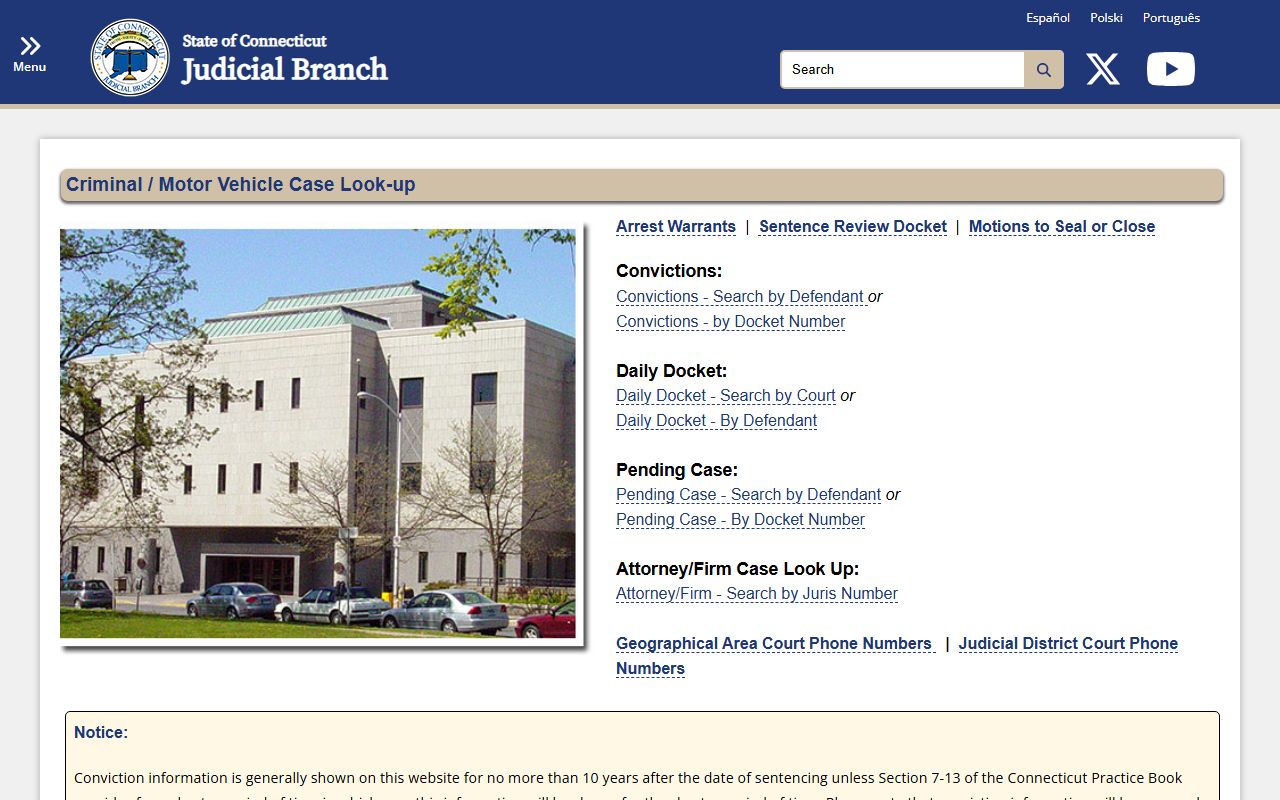
From that hub you choose the right tool for what you need, then enter a name or a docket number. A name search for a pending case takes four steps.
- Open the Judicial Branch Criminal and Motor Vehicle Case Lookup hub and pick the pending case search by defendant.
- Enter the start of the last name, and add a first initial and birth year to narrow same-name results.
- Set the court location to New London JD, GA 10 New London, or GA 21 Norwich based on the arrest town.
- Open the matching case and read the charge list, the charge codes, and the current status of each charge.
For a statewide criminal-history record, the picture is split by office. Court charges and case status come from the Judicial Branch tools. Erased and certain restricted records will not appear, which the state's erasure law, CGS Sec. 54-142a, requires. Older or disposed records may need a written request rather than an online search.
Search Pending Cases by Defendant Name
The most common search starts with a name. The pending criminal and motor vehicle case search by defendant lets the public look up open cases without a docket number. It works best when you know the rough court location and a birth year, because common names return long lists. The fields are simple, but each one shapes the result.
The pending case search by defendant collects a last-name start, an initial, a birth year, a court, and a category.
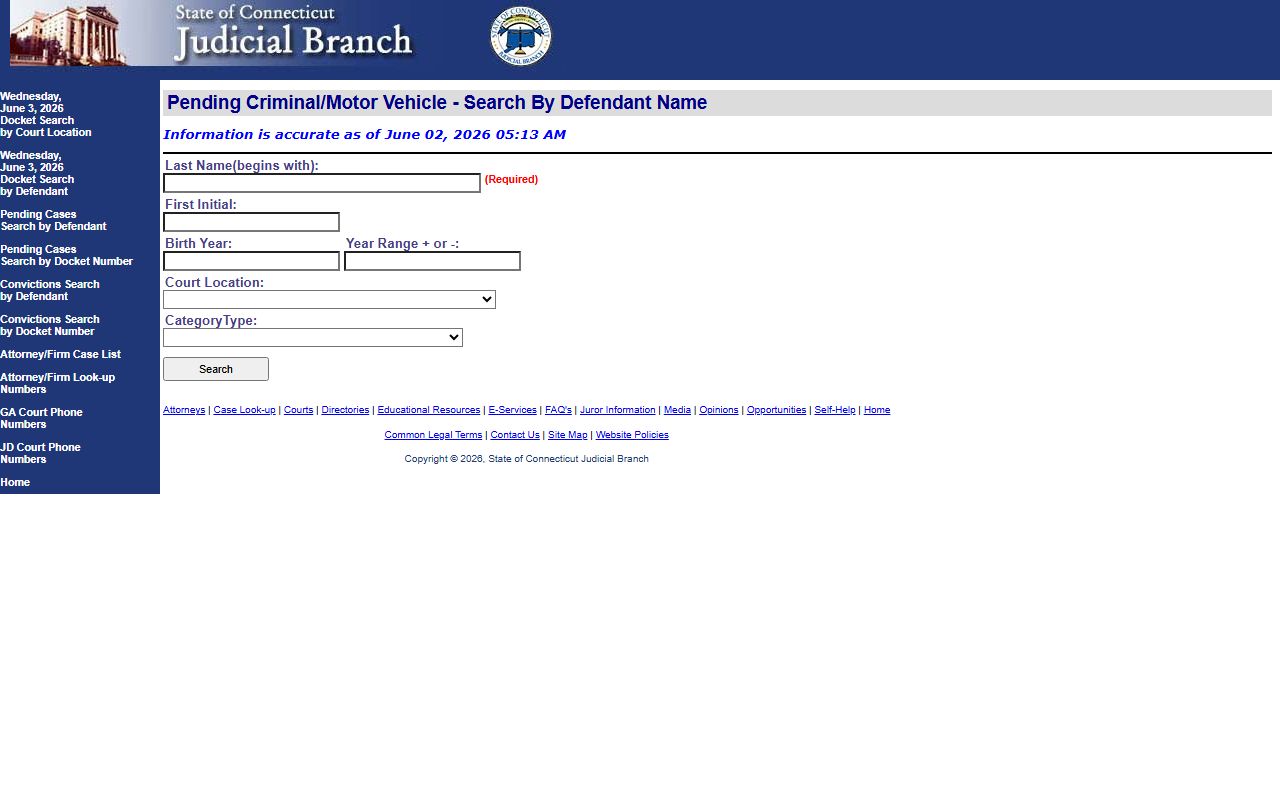
Each field narrows a common name down to the right person.
| Field | Type | Required | Notes |
|---|---|---|---|
| Last Name Begins With | text | yes | Search by the beginning of the last name. |
| First Initial | text | optional | Narrows the defendant search. |
| Birth Year | text or dropdown | optional | Separates people who share a name. |
| Year Range | dropdown or text | optional | Limits the filing or record years. |
| Court Location | dropdown | optional | Pick New London JD, GA 10 New London, or GA 21 Norwich. |
| Category Type | dropdown or radio | optional | Criminal, Motor Vehicle, or referred license/registration suspension. |
Search New London County Court Records by Docket Number
When you have a docket number from a court notice, bond paperwork, a warrant, or a police form, the search by docket number is faster than a name search. A docket number is the case's unique court file number. It is built from parts, and the search asks for each part.
The docket number breaks into a location code, a case type, a year, a number, and sometimes a suffix. Location uses the same codes as the courts above: KNL for the New London Judicial District, K10K for GA 10 New London, and K21N for GA 21 Norwich. The type tells you the kind of case. Common types are CR for criminal, MV for motor vehicle, CI, and MI. The year is the docket year. The number is the numeric case component, and the suffix appears only on some files. Enter the parts as printed on your paperwork to land on the exact case.
Daily Dockets and Conviction Lookups
If you need a court date rather than a case file, use the daily docket by court tool. It lists the cases set for a given court on a given date. One limit matters: the daily docket does not include add-on dockets, the cases squeezed in late. So a same-day arraignment may not show. When the day's schedule is unclear, call the clerk for that court.
For finished cases, the conviction search by defendant reaches guilty dispositions. It uses fields much like the pending search. A display rule applies: conviction information generally shows for no more than 10 years after sentencing, and the record is removed one month before that period ends. Youthful offender, juvenile, infraction, and violation outcomes are not displayed the same way. So a missing conviction does not always mean a clean record.
Note: A daily docket can omit late add-on cases, so always confirm a same-day court date by calling the clerk for the right courthouse.
How Prosecutors File Charges in Connecticut
Connecticut does not use elected county district attorneys. The prosecutor for these cases is the State's Attorney for the Judicial District of New London, Paul J. Narducci. He is the chief law enforcement officer for the district and was reappointed for an eight-year term that began July 1, 2025. His office reviews arrests across the district and decides the formal charges. The court charges, not the arrest charges, drive the case.
The New London State's Attorney page sets out the office, its leadership, and its role in the district.
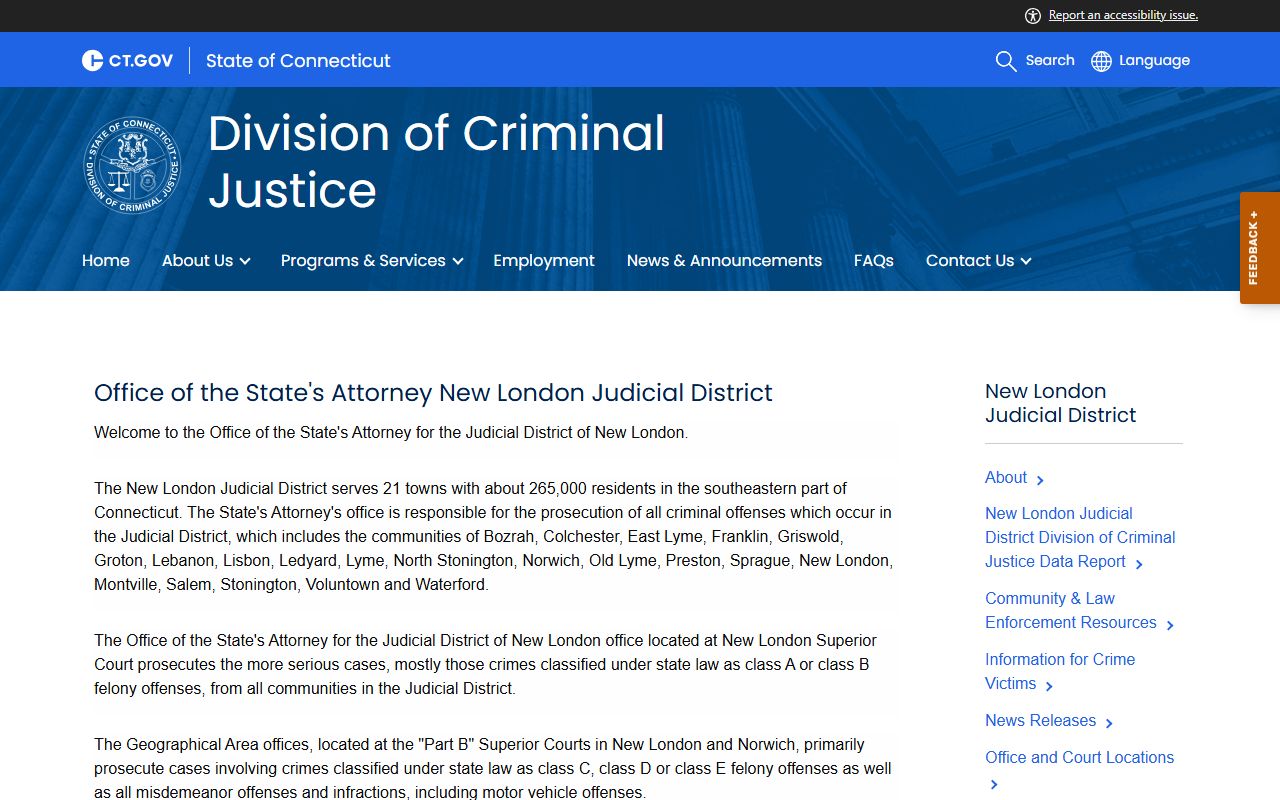
Where a case is filed turns on how serious the charge is. Connecticut does not route cases through a complaint, information, and indictment ladder for this purpose. Instead the office splits the work by court and charge class, as the table shows.
| Court Route | Charge Level Handled |
|---|---|
| New London JD / Part A | More serious cases, mostly class A and class B felonies, from across the district. |
| GA 10 New London | Many class C, D, and E felonies, misdemeanors, infractions, and motor vehicle offenses for its towns. |
| GA 21 Norwich | The same lower-level criminal and motor vehicle matters for its towns. |
Charge Status in a Court Record
A charge does not stay fixed. As a case moves, the prosecutor or the court can change it, and the court record shows where each charge stands. Booking charges from the roster can read differently from the charges the prosecutor finally files, so check the court status rather than the arrest sheet. A few terms come up again and again, and the table defines them.
| Status | What It Means |
|---|---|
| Pending | The charge has not reached a final outcome and the case is still open. |
| Amended or Reduced | The prosecutor or court changed the charge, often to a less serious offense. |
| Dismissed | The court ended the charge. |
| Nolle Prosequi | The prosecutor declines to go forward; erasure rules can later limit disclosure. |
| Conviction | A finding of guilt or an accepted plea, different from the original arrest charge. |
| Erased | The record is no longer publicly disclosable under state erasure law. |
A nolle is a prosecutor's choice to drop the case for now. After a set period it can lead to erasure. So a charge that reads nolle today may vanish from public view later.
Bond and Release After an Arrest
Bond decisions in New London County run through the Judicial Branch, not a county sheriff bond desk. Under CGS Sec. 54-63d, when police do not release a person after arrest, they must notify a bail commissioner or a Judicial Branch Intake, Assessment and Referral specialist. The law calls for the least restrictive condition that still works. A judge starts at the lightest option and moves up only as needed.
| Release Type | How It Works |
|---|---|
| Written promise to appear | A nonfinancial release; the person promises in writing to come to court. |
| Promise with nonfinancial conditions | Release with terms like supervision, no-contact orders, or travel and weapon limits. |
| Bond without surety | A money obligation set with no third-party guarantor. |
| Bond with surety | A bond backed by a surety, used when lighter terms are not enough. |
| Cash bail | Cash posted to secure release; surety means a bondsman or guarantor backs the bond. |
Timing and limits shape who gets out. Intake, Assessment and Referral specialists work court hours, while bail commissioners cover 6:00 p.m. to 4:30 a.m. daily. One rule restricts the lightest options: a person charged with a family violence crime that involves use or threat of a firearm cannot be released on a promise to appear or a nonsurety bond. Cash bail over $10,000 for certain force-related felonies triggers a reporting requirement under the same statute. To check release conditions, call the court clerk or bail services for the right court: GA 10 New London bail services at (860) 447-5125 or GA 21 Norwich bail services at (860) 887-4926. The official sources do not list a public jail bond counter, so confirm payment steps with the court.
Warrants That Lead to a New London County Arrest
Many arrests start with a warrant. A warrant is a judge's order tied to a case, and some warrant types are searchable online. The Judicial Branch runs an arrest warrant search for violations of probation, failures to appear, and orders to incarcerate. A violation of probation warrant follows an alleged breach of probation terms. A failure to appear, sometimes called a bench warrant, follows a missed court date. An order to incarcerate is a court order to take someone into custody.
The Judicial Branch warrant search lets you look by name, town, or court location.
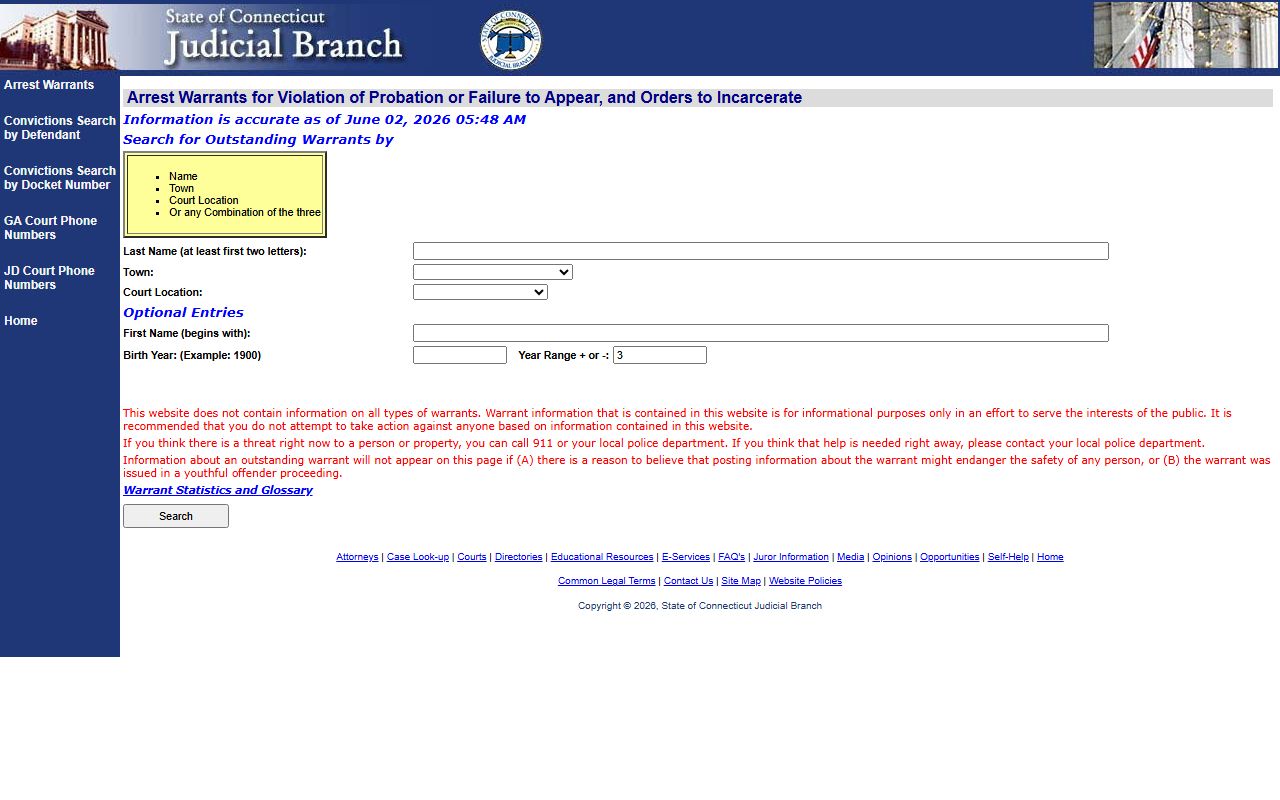
Each search option works on its own or in combination with the others.
| Field | Type | Required | Notes |
|---|---|---|---|
| Last Name | text | one search basis | Search by last name, town, court, or a mix. |
| First Name | text | optional | Narrows a name search. |
| Birth Year | text | optional | Separates same-name results. |
| Year Range | text or dropdown | optional | Limits the warrant record years. |
| Town | dropdown or text | optional basis | Use a New London County town when known. |
| Court Location | dropdown | optional basis | Include New London GA 10, New London JD, or Norwich GA 21. |
The portal does not cover every warrant. It leaves out many warrant types, hides postings where safety could be at risk, and excludes youthful offender proceedings. Active arrest warrants can also sit in police systems or court files outside this tool, so a blank result is not a guarantee.
Charges vs. Convictions in Court Records
Being arrested and charged is not the same as being found guilty. A charge is an accusation. A conviction is the end result after a plea or a trial. The court record can show both stages, and confusing them leads to wrong conclusions about a person.
| Charge | Conviction | |
|---|---|---|
| Stage | Accusation | Plea or verdict |
| Burden of Proof | Probable cause | Beyond a reasonable doubt |
| Public Record | Yes, while pending | Yes, subject to erasure |
Erased Court Records After an Arrest
Connecticut uses the word erasure, not expungement, and it works differently from sealing. Sealing hides a record from public view but the file still exists. Erasure goes further. Under CGS Sec. 54-142a, qualifying police, court, and prosecutor records are erased after outcomes such as a not-guilty finding, a dismissal, a nolle that ages past the statutory period, a pardon, decriminalization, or clean-slate eligibility. An erased record is treated as if the arrest and case never happened for most purposes.
| Sealed | Erased | |
|---|---|---|
| Effect | Hidden from public view | Treated as if it never happened |
| Record Status | File still exists, access limited | Records erased under the statute |
| Authority | Court motions to seal or close | CGS Sec. 54-142a |
The reach goes beyond the court. Under CGS Sec. 54-142e, companies that buy Judicial Branch bulk data and background-screening providers must update and delete erased records before they share them again. So an erased case should drop out of both the court portal and downstream reports over time.
Older or Disposed Court Records
Not every case is in the online tools. Older and disposed Superior Court records often sit in a records center rather than the public portal. To reach them, email the Judicial Branch at SuperiorCourtRecordsCenter@jud.ct.gov or call (860) 263-2750. For most criminal and motor vehicle searches, the Judicial Branch asks for a written request at the geographical area court where the arrest occurred.
A written record search reaches only the court location you name, which is why the GA 10 and GA 21 town split matters. Include the person's name, date of birth, and if you can the arrest or disposition date. Copy fees follow a set rate: court records and documents cost $1.00 per page, while administrative records cost $0.25 per page. Ask the clerk for current totals before you order copies.
Background Check Considerations
A casual court-record lookup is not the same as a regulated background check. Formal screening for jobs, housing, or credit must follow the federal Fair Credit Reporting Act, which sets notice and accuracy rules and bars the use of erased records. The free court tools are fine for personal knowledge, but they are not a compliant screening report.
Important: This is not a consumer reporting agency under the FCRA, and its information may not be used for hiring, housing, credit, insurance, or other covered decisions.
Restricted Court Records After an Arrest in New London County
Some court records are closed or trimmed even when a case exists. The arresting-agency record, the custody record, and the court case record each have their own access rules and their own update times. Records can be withheld or redacted under the state's public-access law, CGS Sec. 1-210, and related statutes.
Common limits include juvenile cases, youthful offender proceedings, and records already erased under state law. Courts also protect a sexual-assault victim's identifying details and a witness's identity, and they can withhold material where release would endanger safety. The arrest record itself is public under CGS Sec. 1-215, yet sealing and exemptions still apply. When a court matter is sealed, juvenile, or erased, expect a clerk to withhold or redact rather than hand over the full file.