
Why There Is No County Jail
Start with the fact that changes everything. New London County has no county government, no sheriff who runs a jail, and no county inmate roster. Connecticut abolished county government on October 1, 1960, and counties survive only as map lines. The Connecticut Secretary of the State explains this on its county register page. Then in 1968 the state folded the old county jails and the state prisons into one agency. That agency is the Connecticut Department of Correction, or CT DOC.
So a "New London County jail" does not exist as a building or an office. The custody function that a county jail would handle elsewhere is handled here by two state prisons that happen to sit inside the county. People call them jails out of habit. On paper they are correctional centers run by the state. That is why the inmate search and the population numbers both come from the state, and why state marshals, who took over parts of the old sheriff role, are not the place to look for someone in custody.
The New London County Inmate Population
The New London County inmate population is best understood as the count of people held in the two CT DOC facilities inside the county. Those are Corrigan Correctional Center in Uncasville, which holds men, and York Correctional Institution in Niantic, which holds women from across the state. Both house people who are accused and waiting for court, plus people already sentenced. The state reports both counts. There is no separate county tally because there is no county jail to keep one.
On June 2, 2026, the two facilities held 1,547 people in total, based on the Connecticut Open Data daily count. That figure means people housed in DOC facilities physically in New London County. It does not mean 1,547 New London County residents are locked up. York draws women from every Connecticut court, so many of those women have no tie to the county at all. Counts move day to day as arrests, bond rulings, sentencings, and transfers shift who is held where.
New London County Inmate Population Statistics
The hard numbers come from two state sources. The Connecticut Open Data portal posts a daily count by facility. The CT DOC monthly statistics report posts point-in-time and average figures each month. For capacity, the only public figure is the designed capacity from each facility's federal PREA audit, because the DOC facility pages do not list a current rated capacity. The stat block below pairs the June 2, 2026 combined daily count with the two designed capacities and the count of facilities in the county.
The combined designed capacity of 2,299 is the sum of Corrigan at 841 and York at 1,458. The figures in the table are sourced and dated. Daily counts use exact-date labels because the state publishes them that way. The state daily data set is the Correctional Facility Daily Population Count, which breaks each facility into accused and sentenced.
| Measure | Figure | Source / Date |
|---|---|---|
| Corrigan total population | 675 | CT Open Data daily count, June 2, 2026 |
| Corrigan accused / other | 290 | CT Open Data daily count, June 2, 2026 |
| Corrigan sentenced | 385 | CT Open Data daily count, June 2, 2026 |
| York total population | 872 | CT Open Data daily count, June 2, 2026 |
| York accused / other | 394 | CT Open Data daily count, June 2, 2026 |
| York sentenced | 478 | CT Open Data daily count, June 2, 2026 |
| Combined county facility population | 1,547 | Corrigan + York, June 2, 2026 |
| Corrigan designed capacity | 841 | Corrigan 2024 PREA final audit |
| York designed capacity | 1,458 | York 2025 PREA final audit |
The CT DOC monthly statistics archive holds current and past population reports for the whole system. Readers can pull the source file from the CT DOC monthly statistics page. The screenshot shows how the state packages the figures behind the New London County inmate population numbers.
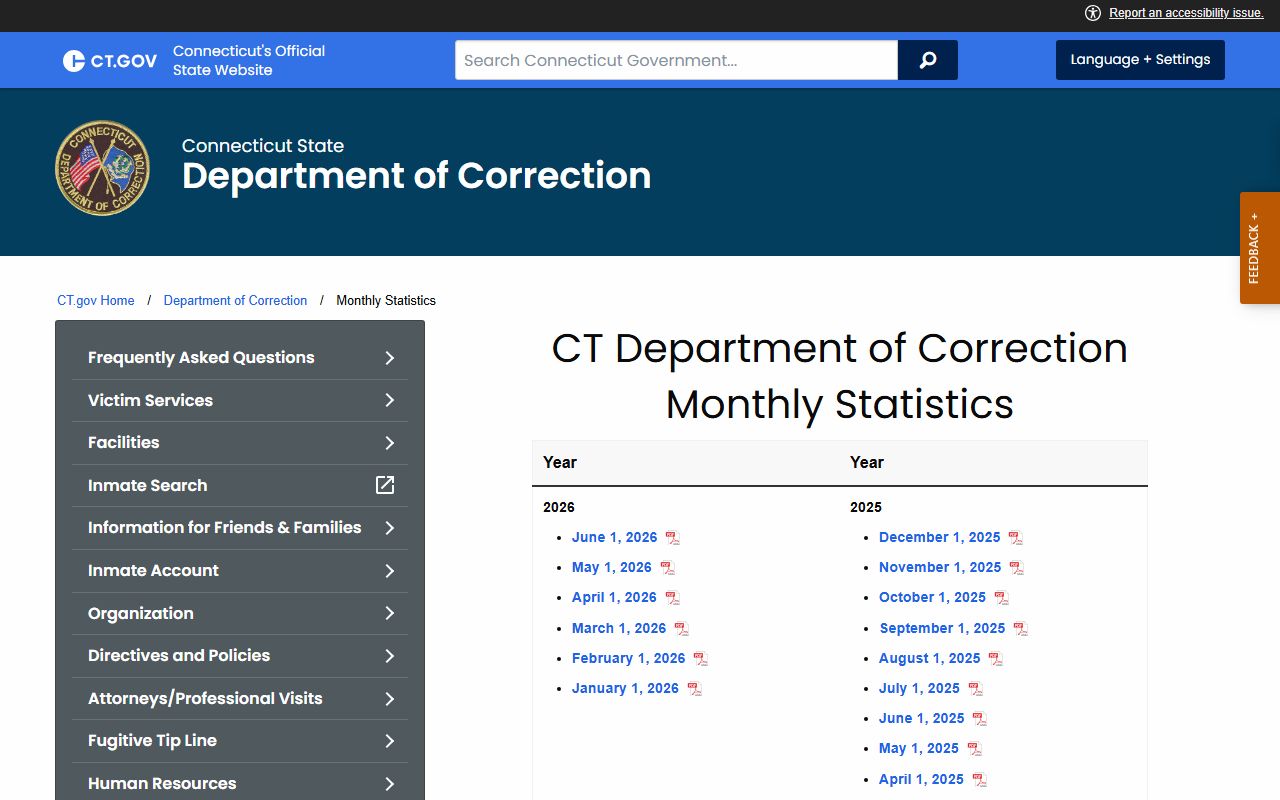
Each monthly file lists average population, facility counts, legal status, gender, race, and age. That is the official trail behind every figure cited here.
New London County Inmate Population Trends
The trend over the past several years runs in two directions. Corrigan, the men's facility, has stayed nearly flat. York, the women's facility, climbed sharply through 2025 and then eased back in 2026. The combined county count peaked in 2025 and fell the next year. These rows use the Connecticut Open Data daily count on June 2 of each year, so the dates line up cleanly. They show the shape of the New London County inmate population, not a forecast.
| Year | Corrigan (June 2) | York (June 2) | Combined |
|---|---|---|---|
| 2021 | 632 | 547 | 1,179 |
| 2024 | 637 | 827 | 1,464 |
| 2025 | 674 | 916 | 1,590 |
| 2026 | 675 | 872 | 1,547 |
Statewide, the same trend held. CT DOC's total supervised population count put the incarcerated figure at 9,020 on July 1, 2021 and 10,584 on July 1, 2024. The total supervised group, which adds parole and community cases, rose from 12,750 to 13,609 over the same span. The drop in York's 2026 number tracks a wider easing in the statewide count after the 2025 peak.
Note: Year-to-year shifts reflect arrests, bond and sentencing decisions, and transfers between facilities, so a single year never tells the full story of the trend.
Who Makes Up the Inmate Population
The CT DOC monthly report for June 1, 2026 breaks the two facilities down by legal status, gender, and race. Legal status is the key split for a custody search. Accused means a person is held while charges are pending. Sentenced means a person is serving a term after a court disposition. A small group at each facility carries federal status in the state's tables. The makeup differs by facility because Corrigan holds men and York holds women.
- Corrigan legal status shows 387 sentenced, 272 accused, and 10 federal on June 1, 2026.
- York legal status shows 478 sentenced, 387 accused, and 9 federal on the same date.
- Corrigan gender was 669 male and 0 female, since it is a men's facility.
- York gender was 874 female and 0 male, the state's only women's prison.
- Race at Corrigan was 210 White, 266 Black, 186 Hispanic, 3 American Indian, and 4 Asian.
York's race breakdown for the same date was 456 White, 230 Black, 177 Hispanic, 4 American Indian, and 7 Asian. The wider context matters too. The Vera Institute reports that Black people were 11 percent of Connecticut residents but 41 percent of the incarcerated population, a gap detailed in its Connecticut incarceration trends.
New London County Jail Capacity
Neither state facility reports a current rated capacity on its public page. The closest official figure is the designed capacity in each federal PREA audit. Corrigan's 2024 audit lists a designed capacity of 841, a current population of 658 at audit, and a 12-month average daily population of 631. The audit also states that Corrigan was not over capacity at any point in the 12 months before the review. That is a precise finding, not a claim that the facility is never crowded.
York's 2025 PREA audit lists a designed capacity of 1,458, a current population of 876 at audit, and a 12-month average daily population of 838. Both facilities have run below their designed capacity in recent counts. The 2025 Office of the Correction Ombuds Conditions of Confinement Report, available from the Office of the Correction Ombuds, flags systemwide strain in staffing, medical care, sanitation, and visitation. It also noted that York lacks a law library. These are oversight findings about conditions, separate from raw capacity.
Note: Designed capacity comes from federal audit forms and may not match a working bed count, so treat it as a planning figure rather than a live limit.
Laws Governing Inmate Records
Several Connecticut laws make custody and arrest data public and set the rules for the population. The state Freedom of Information Act treats agency records as public unless a statute says otherwise. A separate statute defines the record of an arrest as public. The corrections commissioner holds statutory duty over the prisons, and a directive chapter governs how the population is classified and managed. An erasure law removes qualifying records after certain court outcomes. Each one shapes what a reader can and cannot see.
Key Statutes
Connecticut General Statutes Sec. 1-210 makes public agency records open to inspection and copying unless a state or federal law blocks it.
Connecticut General Statutes Sec. 1-215 defines the record of an arrest as public, including basic arrest facts and the warrant or incident report.
Connecticut General Statutes Sec. 18-81 gives the Commissioner of Correction charge over the institutions, custody methods, classification, and statistics.
DOC Administrative Directive Chapter 9 covers population management, offender classification, admissions, transfers, discharges, and inmate remedies.
Connecticut General Statutes Sec. 54-142a erases qualifying criminal records after outcomes such as a dismissal, an acquittal, or a clean-slate disposition.
Because there is no county jail, this information is split across agencies. Current custody runs through CT DOC. Arrest records start with the police department that made the arrest. Court charges run through the Judicial Branch. The split is a direct result of the unified state system.
The State Prison Population Context
The New London County facilities are part of one statewide count, so the state numbers give scale. CT DOC reported an average confined population of 10,771 for May 2026 in its monthly statistics, published June 1, 2026. Of that average, 3,426 people, or 31.8 percent, were accused. The remaining 7,345, or 68.2 percent, were sentenced. The Prison Policy Initiative puts Connecticut's overall incarceration rate at 326 per 100,000 in its Connecticut profile.
The unified system also explains a data gap. National jail surveys treat county jails as separate from state prisons, but Connecticut has no county jails to count. The Bureau of Justice Statistics excludes combined jail-prison systems from its local jail coverage, as noted in its Jail Inmates in 2023 tables. So a true county jail rate for New London County does not exist. The county-level number that does exist is the facility population at Corrigan and York, which is the figure used throughout these sections.
How to Search the Inmate Population
Because there is no county roster, the search runs through the CT DOC statewide inmate locator. That tool covers everyone in DOC custody right now, which includes both Corrigan and York. It is free, public, and updated once a day. Start at the DOC inmate information page so the caveats are clear before the search. The locator itself lives at a separate state web address. A name or a DOC number is enough to begin.
The lead-in screenshot below shows the CT DOC inmate lookup portal, which is the front door for a New London County inmate search. The portal is reached at the CT DOC inmate information search. The image illustrates where a name or DOC number gets entered to find a person in custody.
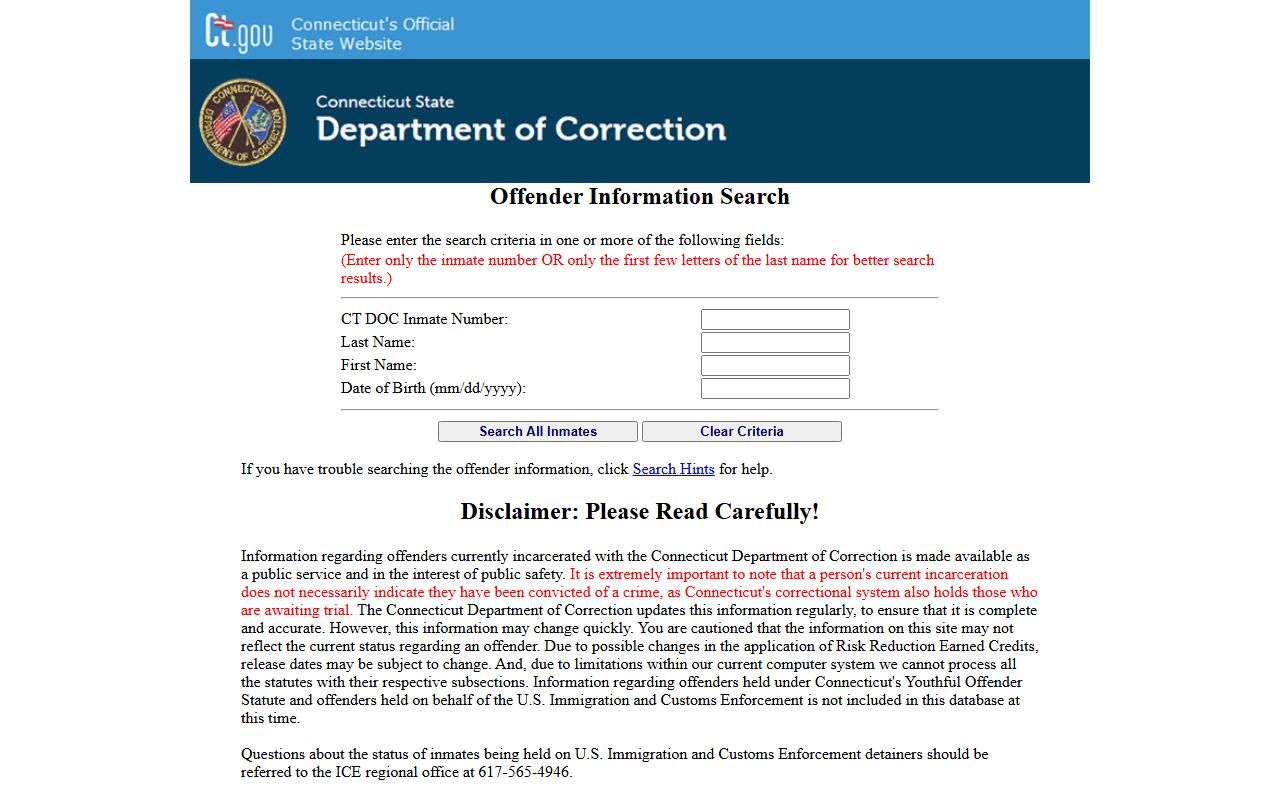
The steps below follow the order the state recommends. Read the caveats first, then search by the narrowest identifier you have.
- Open the CT DOC Inmate Information page to read the daily-update and exclusion notes.
- Search by CT DOC number if you know it, since that is the narrowest identifier.
- If the DOC number is unknown, search by name and date of birth, the fields the state lists.
- If the person is female, check York; if male and tied to local courts, check Corrigan.
- If no result appears, allow for the daily update lag and then try the court dockets.
Current Inmate Lookup in New London County
The state's correctional services page confirms the three search fields a citizen can use: the CT DOC number, the name, and the date of birth. The locator updates once a day, so a person arrested hours ago may not show yet. The state warns that current custody does not prove a conviction, since the system holds accused people waiting for trial alongside sentenced people. The exact field order and button labels could not be verified, because the live portal blocked automated inspection. The fields below come from the state's official service description.
| Field Label | Type | Required | Notes |
|---|---|---|---|
| CT DOC Number | Text | Unspecified | State service page says the search can use the DOC number. |
| Name | Text | Unspecified | Name is a listed field; exact first and last layout not verified. |
| Date of Birth | Date / text | Unspecified | Listed as a search field; display format not verified. |
For help by phone, the DOC Public Information Office answers at (860) 692-7780 from 8:00 a.m. to 4:30 p.m., Monday through Friday. The roster how-to gets fuller treatment on the jail inmate records page, including the full fallback chain.
Past and Released Inmate Records
Finding someone no longer in custody takes a different route. The DOC locator is built for people under current supervision, so a released person may drop off the search. No official retention period for released listings was published, so there is no fixed window to cite. For a record that never appears online or that you need after release, a public records request is the path. Arrest and booking records start with the police agency that made the arrest, under the state arrest-record statute.
Court case history is often the better trail for past matters. The Judicial Branch keeps pending cases, convictions, and dockets in its online lookup. Convictions generally display for up to 10 years after sentencing. For records that the state has erased after a dismissal or clean-slate outcome, the data is removed from disclosure by law, so it will not appear. The court pathway is covered in depth on the court records after jail arrest page.
What an Inmate Record Shows
A New London County inmate search returns a DOC record, not a county jail booking profile. The state describes what the system provides, though the live portal blocked a sample profile from being inspected. The field table below is built from the state's own descriptions. It shows the identifiers the locator uses and the status it reports. It does not promise a mugshot, because public photo display in the DOC locator was not verified and should not be assumed.
| Field | What It Shows |
|---|---|
| CT DOC Number | The state correctional identifier when known, used to locate a person. |
| Name | The current inmate name; exact display layout not verified. |
| Date of Birth | A search identifier; public display not verified. |
| Facility / Location | Where the person is held, such as Corrigan or York, when shown. |
| Custody Status | Current DOC custody; the state warns this does not prove a conviction. |
| Update Timing | The state says the information is updated daily, not in real time. |
Charges and sentence detail should be confirmed through the Judicial Branch case lookup, since the court record is the authoritative source for charges. Release dates, where shown, can change and should not be treated as fixed.
Custody Terms Defined
Custody language can blur the difference between people held before trial and people serving a sentence. A few plain definitions keep the New London County inmate population in focus. These terms come straight from the state's own usage and from court process.
- Accused
- A person held before conviction while charges are still pending in court.
- Sentenced
- A person serving a term after a conviction or other court disposition.
- Detainer
- A hold or notice from another agency, such as ICE or another jurisdiction.
- CT DOC number
- The state correctional identifier used to find a person in DOC systems.
- Erasure
- A Connecticut process that removes qualifying records from disclosure after certain outcomes.
Youthful offender records sit in a protected category and are kept out of the public DOC search. That term matters when a young person does not appear in the locator.
County Custody vs. Federal Systems
Readers mix up three custody systems all the time. State custody, federal custody, and immigration detention are run by different agencies and searched in different places. The CT DOC locator covers state custody, which includes both accused and sentenced people at Corrigan and York. Federal prisoners are not in the DOC system. ICE detainees are excluded from the DOC search by the state's own rule. The table sorts out which lookup covers which group.
| State (CT DOC) | Federal (BOP) | Immigration (ICE) | |
|---|---|---|---|
| Who Is Held | Accused and sentenced in CT | Federal Bureau of Prisons custody | Immigration detainees |
| Run By | Connecticut Department of Correction | Federal Bureau of Prisons | U.S. Immigration and Customs Enforcement |
| Where to Look | CT DOC inmate locator | BOP inmate locator | ICE detainee locator |
| In the County | Corrigan and York | None in the county | None in the county |
One failed search does not end the hunt. A person can move from police custody to court, to DOC, to federal or immigration custody, or be released. Checking the right system for the right stage is the whole trick.
State and Federal Inmate Search
When the state locator comes up empty, the next tools depend on the custody stage. For federal prisoners, the Federal Bureau of Prisons runs its own search. No BOP prison sits in New London County; Connecticut's federal facility is FCI Danbury, well outside the county. The BOP locator at the federal inmate locator takes a register number or a name. The DOJ also lists locator resources through its locate-an-inmate page.
For immigration detention, ICE runs the Online Detainee Locator. The state explicitly says people held for ICE are not in the DOC database. The ICE tool at the ICE detainee locator searches by an A-number with country of birth, or by name with country of birth. It does not search minors under 18. For custody and court alerts, the VINELink notification service at VINELink lets a person register for updates, though it is a notification tool, not a full roster.
Note: Federal and immigration systems generally do not publish local booking photos, so do not expect a mugshot from a BOP or ICE search result.
Court and Warrant Pathway
If a person was arrested but does not appear in DOC custody, the court system is the next stop. Many people are released before any DOC admission, so the court record is where the case lives. The Connecticut Judicial Branch runs a criminal and motor vehicle case lookup for pending cases, convictions, and daily dockets. Local arrests route through the New London Judicial District, with Geographical Area 10 in New London and Geographical Area 21 in Norwich, depending on the town and charge level.
The case lookup hub at the Judicial Branch criminal case lookup links each search type. For a suspected warrant, the Judicial Branch posts a separate warrants search for violation of probation, failure to appear, and orders to incarcerate, though it does not list every warrant type. Booking photos for an arrest are handled on the jail roster mugshots page, since the DOC locator does not promise them.
New London County Detention Facilities
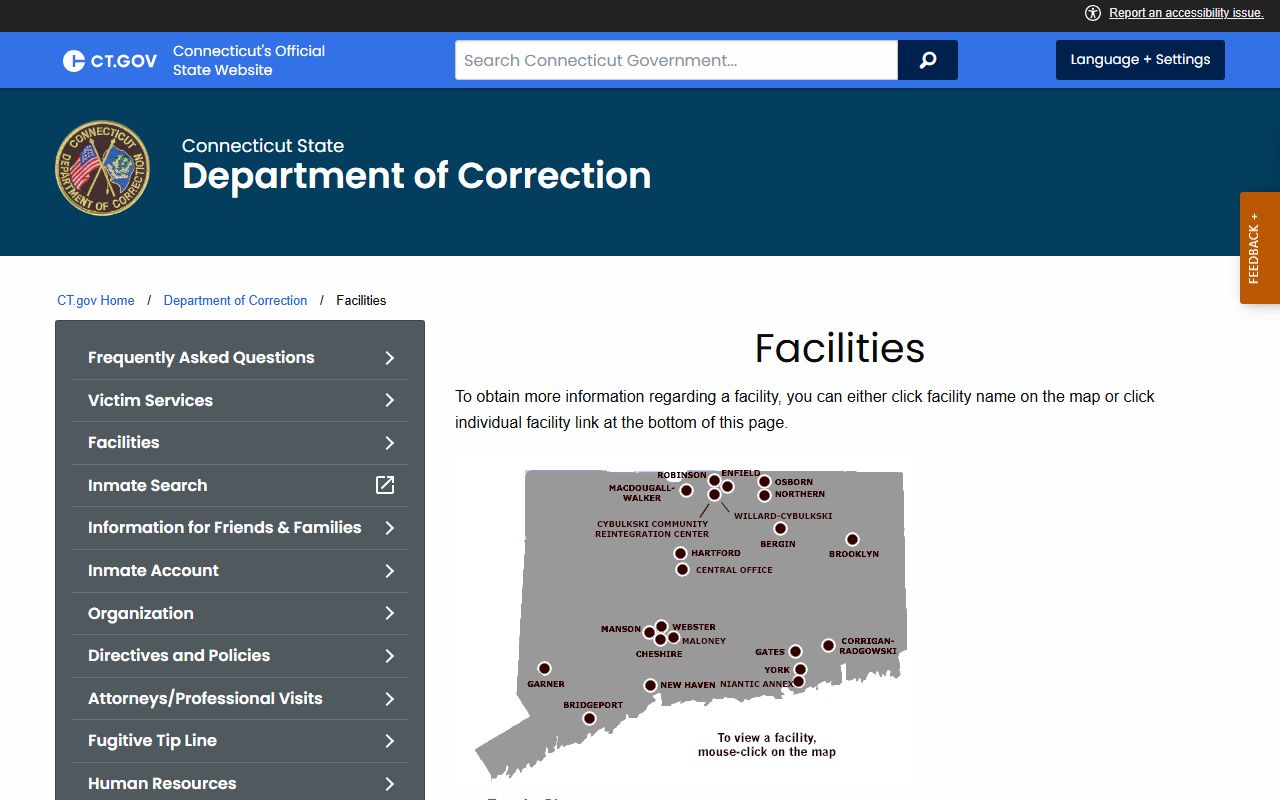
Two state correctional facilities sit inside New London County, and both feed the county inmate population count. No active federal prison, ICE center, or local jail with an online roster was found in official sources. The facilities map and list on the state site shows where each one sits in the wider DOC network. The order below puts the men's facility first, then the statewide women's facility.
The CT DOC facilities map and list confirms there is no county jail and shows the two facilities serving the county. It is published on the CT DOC facilities page. The screenshot ties the facility list back to the wider state correctional network behind the inmate population.
- Corrigan Correctional Center holds men who are accused or sentenced and serves courts in Danielson, New London, Norwich, and Windham.
- York Correctional Institution is Connecticut's only institution for female offenders, holding accused and sentenced women plus female offenders under 18.
New London County Inmate Population FAQ
How big is the New London County inmate population?
On June 2, 2026, the two state facilities in the county held 1,547 people combined, per the Connecticut Open Data daily count. Corrigan held 675 men and York held 872 women. That figure counts people housed in DOC facilities physically in New London County, not county residents in custody. York draws women from every Connecticut court, so many have no county tie.
Why is there no New London County jail roster?
Connecticut abolished county government in 1960 and unified its county jails and prisons under one state agency in 1968. There is no county sheriff who runs a jail and no county roster. Custody is handled by the Connecticut Department of Correction. The official inmate search is the statewide CT DOC locator, not a county tool, and state marshals do not operate inmate housing.
How do I search the New London County inmate population?
Use the CT DOC statewide inmate locator. You can search by CT DOC number, by name, or by date of birth, per the state's correctional services page. The locator covers both Corrigan and York. It updates once a day, so a recent arrest may not show right away. The DOC Public Information Office can help by phone at (860) 692-7780.
Are accused and sentenced people both counted?
Yes. Both Corrigan and York hold accused people waiting for court and sentenced people serving terms. On June 1, 2026, Corrigan reported 272 accused and 387 sentenced. York reported 387 accused and 478 sentenced. The state warns that current custody does not prove a conviction, since accused people are held before trial.
What if the DOC search finds no result?
Check the custody stage. A recent arrest may not be in DOC yet because the system updates daily. The person may be released, held federally, or held by ICE, which the DOC search excludes. Youthful offender records are also excluded. Try the Judicial Branch court dockets, the BOP locator, or the ICE locator depending on the situation.
Can I look up a released or past inmate?
The DOC locator is built for current custody, so a released person may not appear. No official retention period for released listings was published. For past records, use the Judicial Branch case lookup, which keeps convictions for up to 10 years after sentencing. For arrest or booking records, file a public records request with the arresting police agency.